

Current activities:
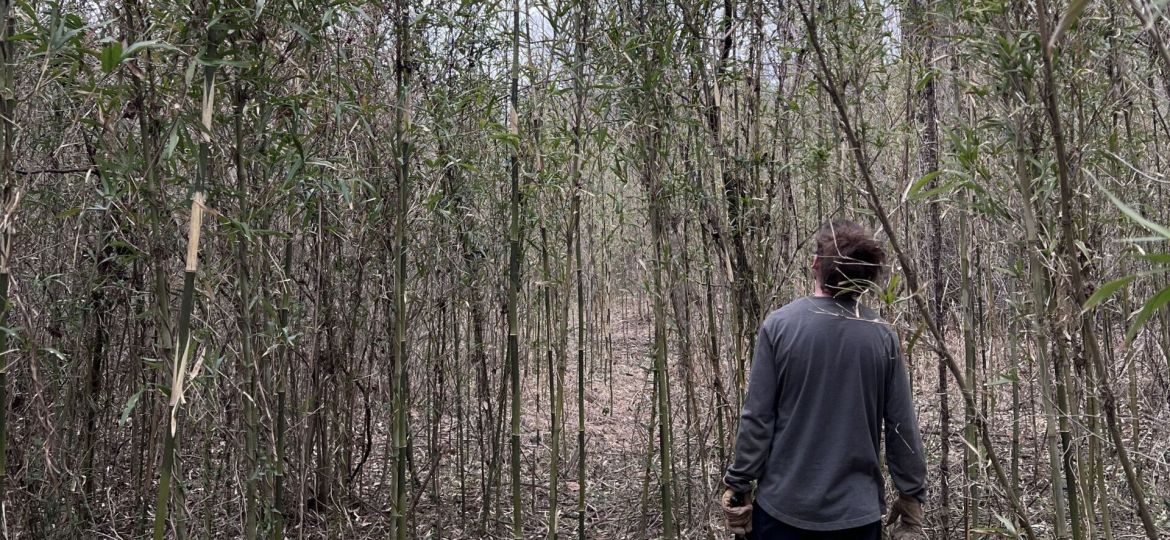
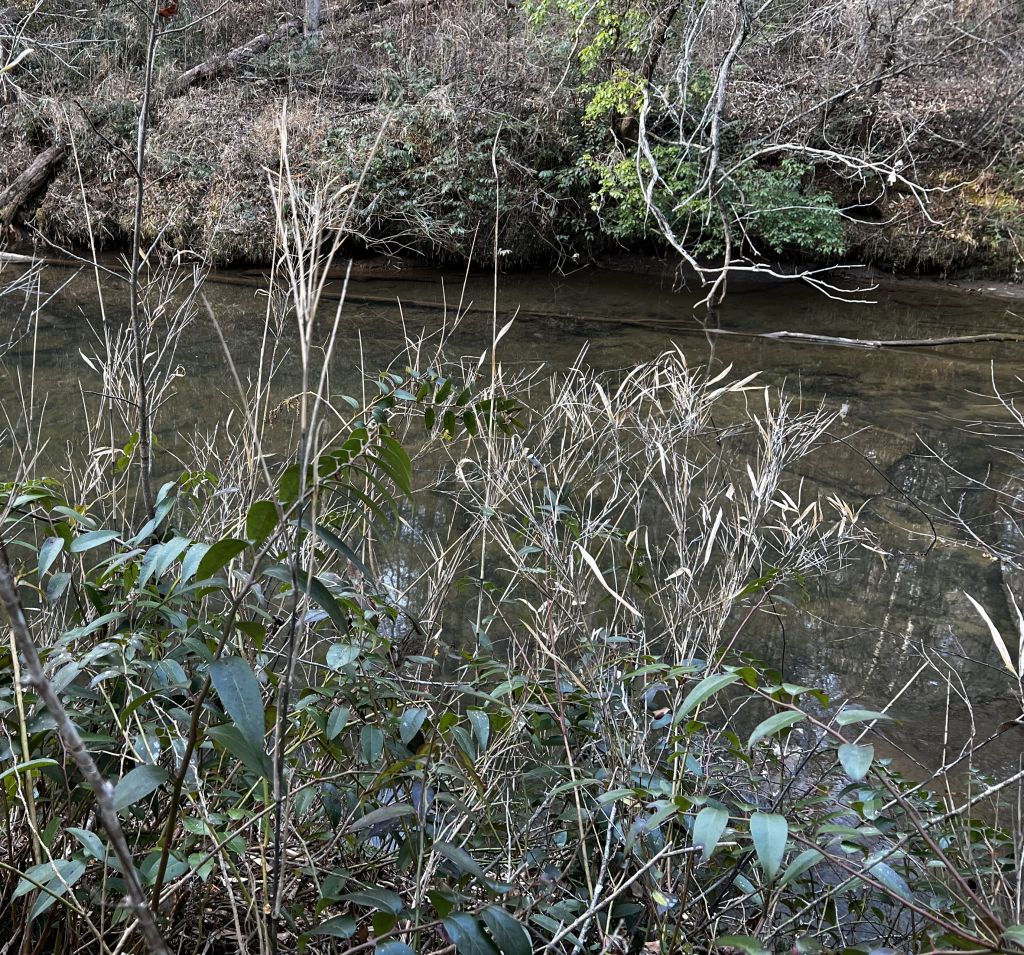
In the wake of a major setback (see “Forest Service Contractor Error Destroys Prized River Cane”) we have regrouped to focus on nurturing a stand of native cane just upstream of the Highway 28 Bridge, on the Chattooga River’s SC bank. This small stand of superior native River Cane (Arundinaria gigantea) was inundated with nonnative invasive species (NNIS), including Rosa multiflora, Privet, Autumn Olive, Japanese honeysuckle and other noxious plants. With the removal of invasives that take up canopy and ground space, River Cane is given room to grow and flourish.
Gigantea prefers to grow along undisturbed banks of streams and rivers, on slightly elevated mounds or small rises where the soil is less saturated than in low-lying, consistently submerged spots. To optimize effort and outcome, the removal of invasive species in the Highway 28 Bridge cane patch has prioritized the clearing of slightly elevated surfaces. Because we have seen that river cane rhizomes are quite intolerant to the presence of herbicides, the NNIS eradication work is being accomplished through demanding and persistent manual labor—digging up NNIS one at a time. Daily work over this past fall and winter in this zone of the overall project site is releasing a beautiful stand of gigantea.
Species identification:
While our Native Cane Restoration Project focuses specifically on restoring River Cane, there are three species of cane native to our area: Arundinaria gigantea (River Cane), Arundinaria tecta (Switch Cane), and Arundinaria appalachiana (Hill Cane). All three native canes are technically types of bamboo, but are vastly different from nonnative/invasive bamboos, like species in the genus Phyllostachys (including golden bamboo). One of the easiest ways to differentiate native cane species from invasive bamboo is branch angle: native cane branches start nearly parallel to the culm (stalk), where invasive bamboo branches take off at a wider, 45°–90° angle.
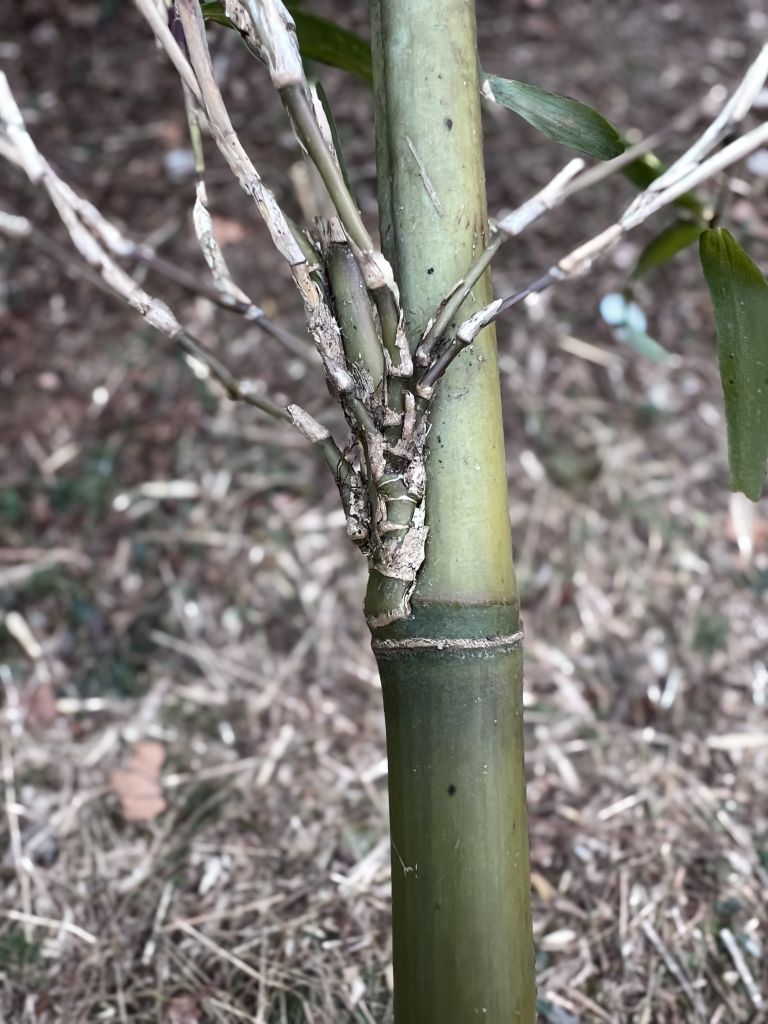
Native cane primary branches begin nearly parallel with the culm.
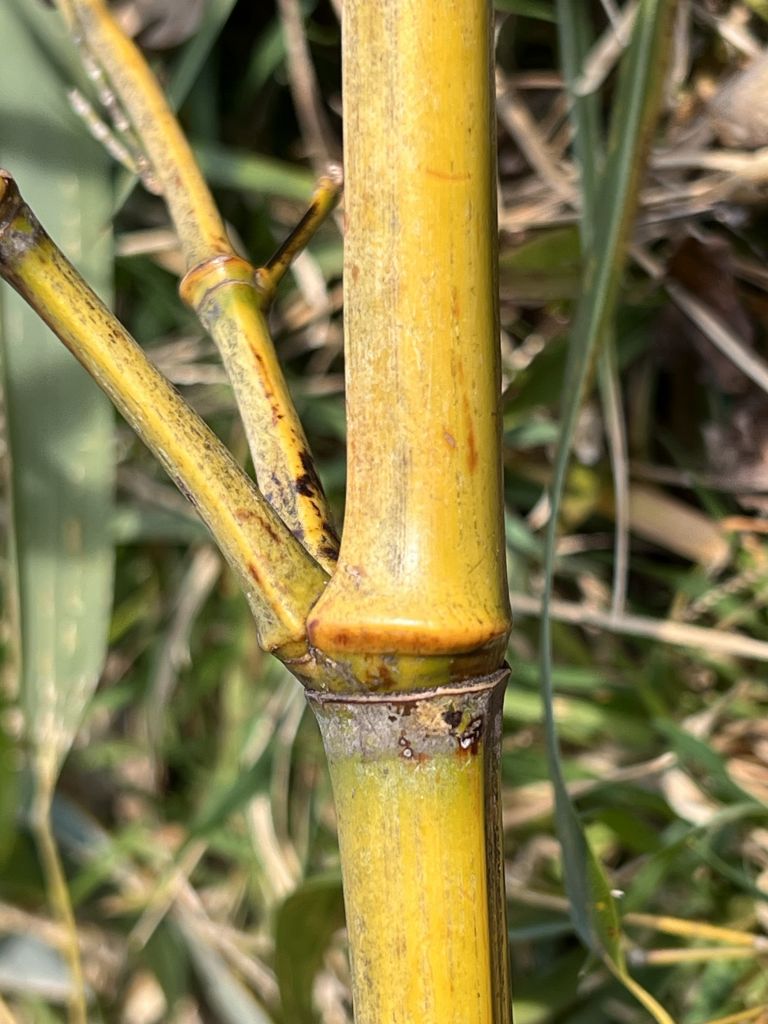
Distinctions among the three native species are subtle; in fact, western scientific understanding of these three native cane species was formalized as recently as 2006. For several decades before then, Switch Cane was considered a subspecies of River Cane, and Hill Cane had not yet been officially named! Hybridization observed between the native cane species further complicates identification and species distinctions. Here are some key elements of each of our three native cane species:
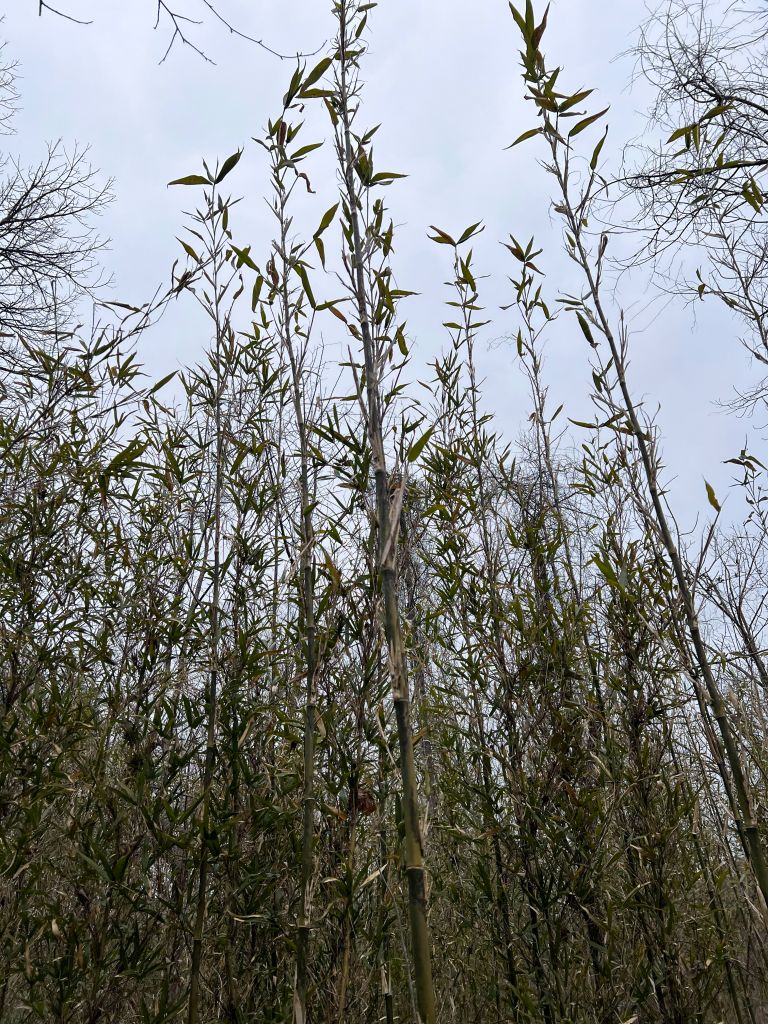
When mature, River Cane (above) is the tallest of the three species, reaching heights as tall as 25 feet! It hosts a “top knot” of 6 to 8 leaves, with top-knot leaves between 16–24 cm long.
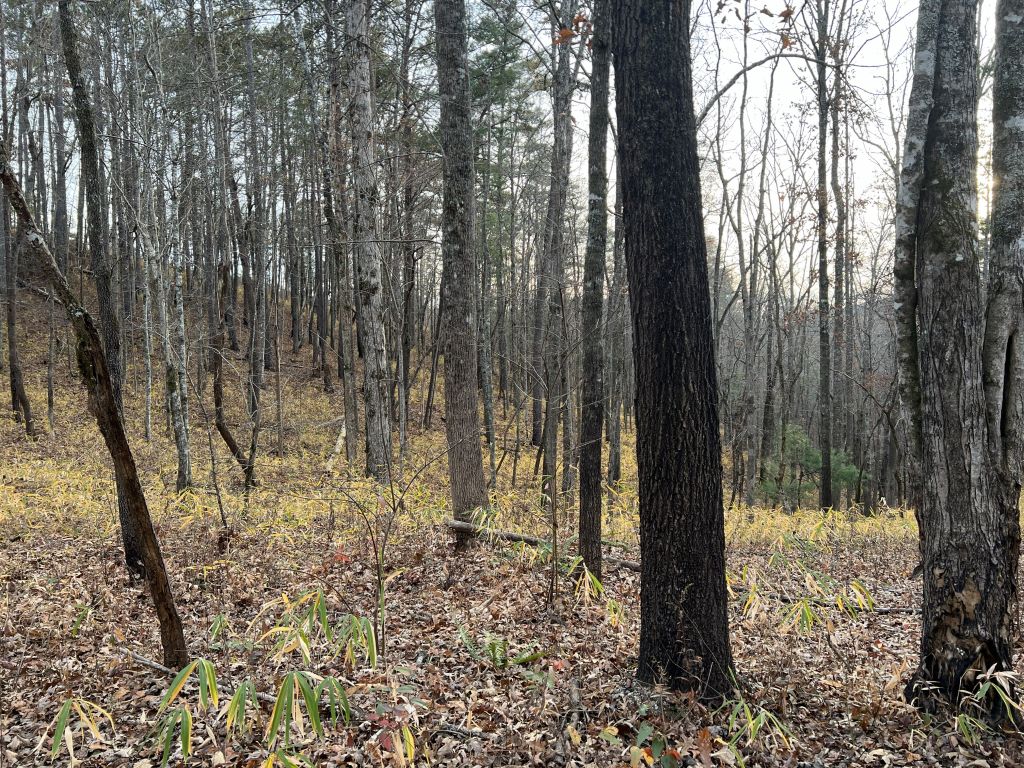
Hill Cane (right, yellow and green foliage) grows in large colonies along dry hillsides and ridges, topping out around three feet in height when mature. It has top knots of 6–12 leaves, ranging between 9–22.5 cm long.
Differentiation:
Even though genetically, Switch Cane and Hill Cane are the most closely related, it is perhaps easiest to distinguish Hill Cane from the other two species, thanks to its short stature and preference for hillsides and ridges. In riparian areas, mature River Cane can be distinguished from the other native canes by its height. (Over 12 feet? It’s River Cane!)
One further clue involves a closer look at the plant, specifically at what are known as “compressed internodes”: lines at the base of primary branches that look like a flattened telescoping antenna. River Cane will have only 0-1 compressed nodes on its branches, while Switch Cane or Hill Cane can have 2-5.
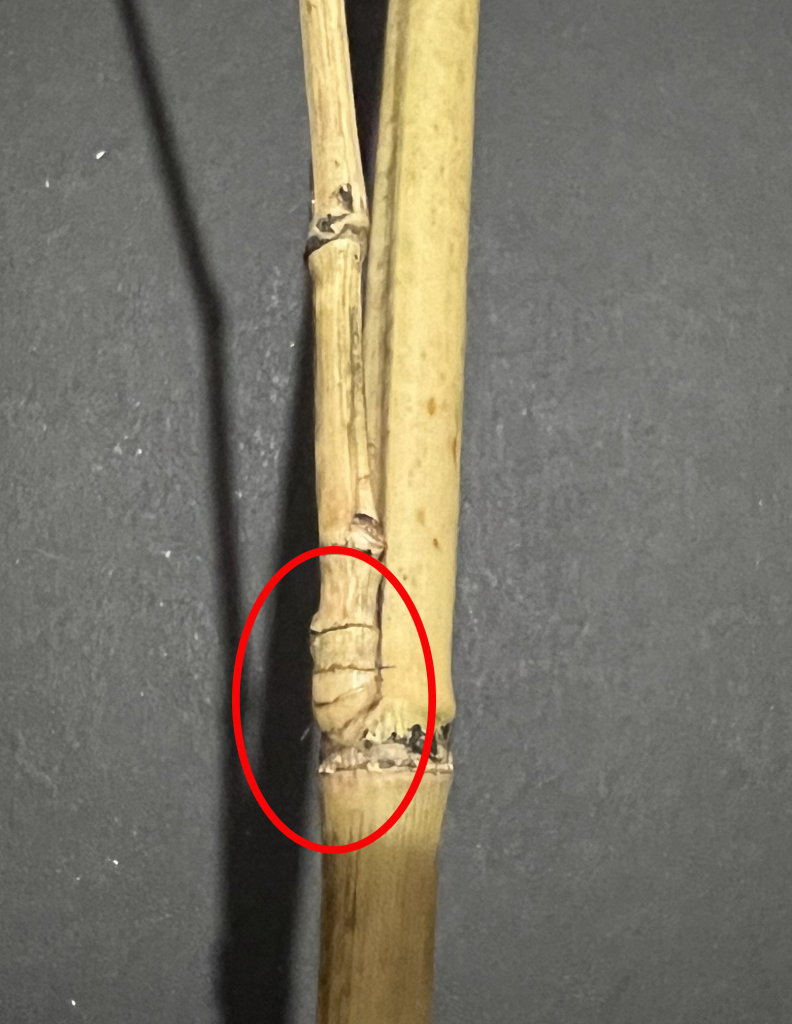
This example of Arundinaria tecta (left) shows 4 compressed basal internodes on a primary branch.
[Note: A fourth species of native cane, Arundinaria alabamensis, or Tallapoosa Cane, a close genetic relative to Switch Cane and Hill Cane, was identified as a new species in Alabama in 2023. Tallapoosa Cane has not yet been identified outside of Alabama.
Cultural value:
While often similar in visual appearance to Switch and Hill Cane, River Cane possesses unique characteristics that make it a desirable cane species for certain Indigenous cultural practices, such as artisan basket weaving, where mature River Cane is prized for its durable and flexible culms (stems). River Cane culms are also preferred for blowguns, as they can grow taller, straighter, and to a larger diameter than those of other native canes. Other Indigenous cultural practices could use materials from the other native canes; for instance, materials from Switch Cane can be used to make arrows. Artisan preferences among the cane species are dictated by varied factors including tradition and local cane species availability (Cherokee traditions for cane in North Carolina may differ from Choctaw traditions in Oklahoma), as well as by the personal choices of each individual artisan.
The Highway 28 Bridge restoration project is conducted in cooperation with the Eastern Band of Cherokee Indians (EBCI) and supported in part by a grant from the Cherokee Preservation Foundation (CPF) and Revitalization of Traditional Cherokee Artisan Resources (RTCAR). One of the project’s goals is to supply EBCI artisans with raw cane materials.
Ecological value:
Canebrake ecosystems—dense, often clonal populations of River Cane or Switch Cane—were once widespread in floodplains throughout the Southeast, but are now considered imperiled, after land conversion and agricultural/grazing practices by settler colonists decimated former cane populations. Canebrake ecosystems are ecologically important for streambank stabilization and wildlife habitat.
Additional sources:
Fedoroff, M. P., & McKain, M. R. (Presenters). (2026). Rivercane Genetics [Webinar]. Rivercane Gathering. https://usfs.tribalgis.com/index.php/videos/video/rivercane-genetics
Fourkiller, J. (2021). Cherokee artist continues tradition of blowgun making [Video]. Cherokeephoenix.org. https://www.cherokeephoenix.org/culture/cherokee-artist-continues-tradition-of-blowgun-making/article_8bdb146c-a9b3-11eb-9c3e-976c63d1052f.html
Griffith, A. (2025). What is Rivercane and why is it important? EBCI Center. https://ebci.ces.ncsu.edu/news/what-is-rivercane-and-why-is-it-important/
Harkness, H. (2024). Rivercane: Our Native Bamboo. National Park Service. https://www.nps.gov/articles/000/rivercane.htm
Meyer, D. (2013). Hunting with Cane: Traditional Cherokee Blowguns and Darts. EXARC Journal, 2013/3. https://exarc.net/ark:/88735/10136
Thompson, I. (Presenter). (2025). Cultural Uses of Rivercane [Webinar]. Rivercane Gathering. https://usfs.tribalgis.com/index.php/videos/video/cultural-uses-of-rivercane
Header image: Chattooga Conservancy contractor Austin Dominique has dedicated months to releasing River Cane from NNIS competition at the Highway 28 Bridge restoration site, over fall/winter 2025–2026. All photos in this article by Isabel Blue.