

South Carolina: Sumter National Forest, Andrew Pickens Ranger District
Public land in the Chauga River watershed and in SC portions of the Chattooga River watershed belongs to Sumter National Forest, administered by the Andrew Pickens Ranger District (APD). Timber harvest activities could belong to one of two ongoing APD timber projects: the Loblolly Pine Removal and Restoration Project (“Loblolly Project”) or the White Pine Management Project (“White Pine Project”). Much of the timber harvesting in these projects will be accomplished by clearcutting.
The Loblolly Project was approved back in 2013 and supplemented in 2018. Implementation of the project is ongoing. With a stated purpose “to restore native vegetation typical of the Southern Appalachian Mountains in areas that were planted to non-native loblolly pine,” the total project includes prescriptions for:
- cutting 6,872 acres of non-native loblolly stands,
- burning 4,369 acres, herbicide application on at least 5,542 acres,
- 57 miles of road maintenance/reconstruction,
- 37 miles of temporary roads, and
- 8 miles of bulldozer fire lines
While the Chattooga Conservancy agreed that removal of Loblolly Pines (an introduced, non-native species) could benefit our local ecosystems if conducted appropriately, we expressed concerns throughout the planning process about many project details. Our input resulted in some favorable modifications to the 2013 project plan, such as reducing the density of native pine seedlings to be planted after logging and reducing the miles of road construction. However, many of these gains were offset or reversed by the project supplement in 2018, which approved an additional 1,300 acres of logging, more road construction/reconstruction, and allowing trucks to drive through perennial and intermittent streams.
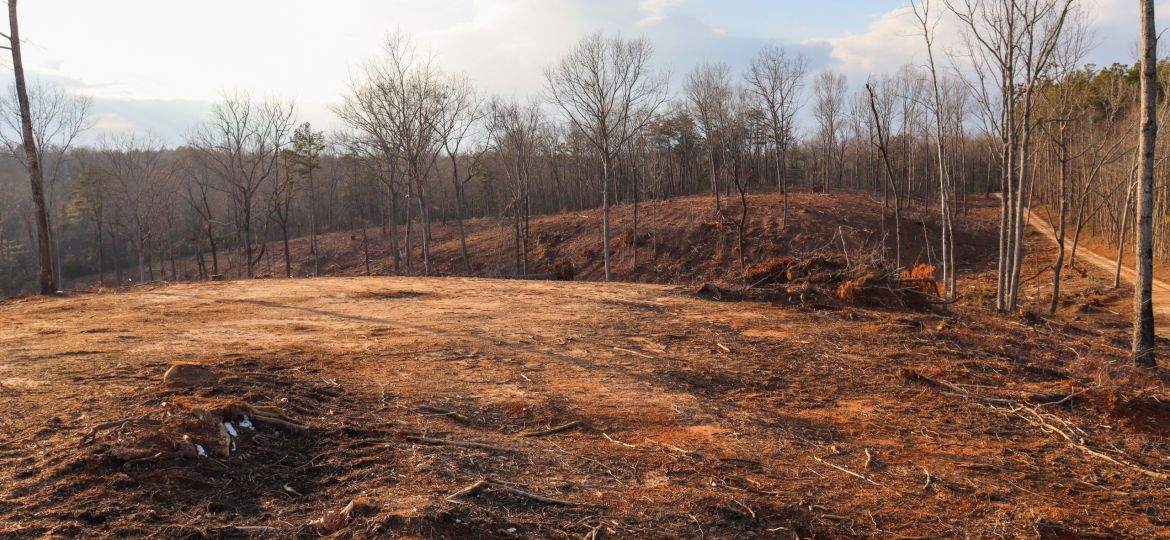
Where you may have seen it implemented recently: the Loblolly Project includes stands cut along the Woodall Shoals Road in the Chattooga watershed in 2023/2024 and stands cut along Double Branch Road in the Chauga watershed in late 2025/early 2026. Note: some future harvests along each of these roads will be conducted under the White Pine Project.
The White Pine Project was finalized in 2021. The Chattooga Conservancy participated throughout USFS’s public review process for the White Pine Project, and we were able to eke out a few favorable modifications: the project’s timber harvest acreage was reduced by 20 acres; a few stands were changed from clearcuts to thinning/group selection and/or had boundary modifications; maps and project documents were updated to more clearly indicate stand access routes; and a design criterion was added for a buffer—if possible—around a wetland area and an exceptionally large patch of pink lady slippers in one stand.
After these modifications, the White Pine Project includes prescriptions for:
- timber harvest on 1,952 acres,
- herbicide application on up to 1,425 acres,
- prescribed burning on up to 1,195 acres, and
- 12 miles of temporary roads.
Where you may have seen it implemented recently: the White Pine Project is newer relative to the Loblolly Pine Project; hence, many of the stands included in the project have yet to be harvested. Among the harvests that have been completed are stands south of Cassidy Bridge Road in the Chauga watershed, harvested in 2023/2024.
The 2023/2024 harvests along and near Grapevine Branch Road belong to a combination of the White Pine Project and the Loblolly Project, plus an adjacent harvest on private land. Note that the concurrent implementation of the Loblolly and White Pine Projects prompted Sumter National Forest to amend their Forest Plan, to permit contiguous clearcutting of areas totaling more than 40 acres in size.
North Carolina: Nantahala National Forest, Nantahala Ranger District
Public land in the NC portion of the Chattooga River watershed belongs to Nantahala National Forest, administered by the Nantahala Ranger District (NRD), and ongoing timber activities are part of the Southside Project.
Finalized in 2019, the Southside Project sparked controversy over its prescriptions to harvest mature and old-growth forest, including important stands within or near the Chattooga headwaters. The Chattooga Conservancy again submitted comments throughout the project planning process. One of our objections made it to court in 2024 and, six months later, resulted in the NRD withdrawing plans to log a 15-acre stand in a “Special Interest Area” near the Whitewater River—a win for conservation. Unfortunately, one of our other objections met a devastating loss: despite overwhelming public opposition, USFS sold a 37-acre forest stand on top of Brushy Mountain, containing rare old growth (in excess of 200 years old) and critical habitat for the imperiled Green Salamander, as part of the Southside Project. Timber harvesting on Brushy Mountain was completed in fall 2024.
In total, the Southside Project includes:
- timber harvest on 317 acres
- herbicide applications throughout timber harvesting sites and on roads and skid trails, and
- burning 37 acres, in combination with a separate but connected proposal to burn 722 acres at Bull Pen and 956 acres at the eastern portion of the project area around Jacks Creek.
Where you may have seen it implemented most recently: Brushy Mountain in 2024. Additionally, as of early 2026, Southside Project timber harvest activities have begun near Slick Rock, off Horse Cove Road (west of Bull Pen Bridge).
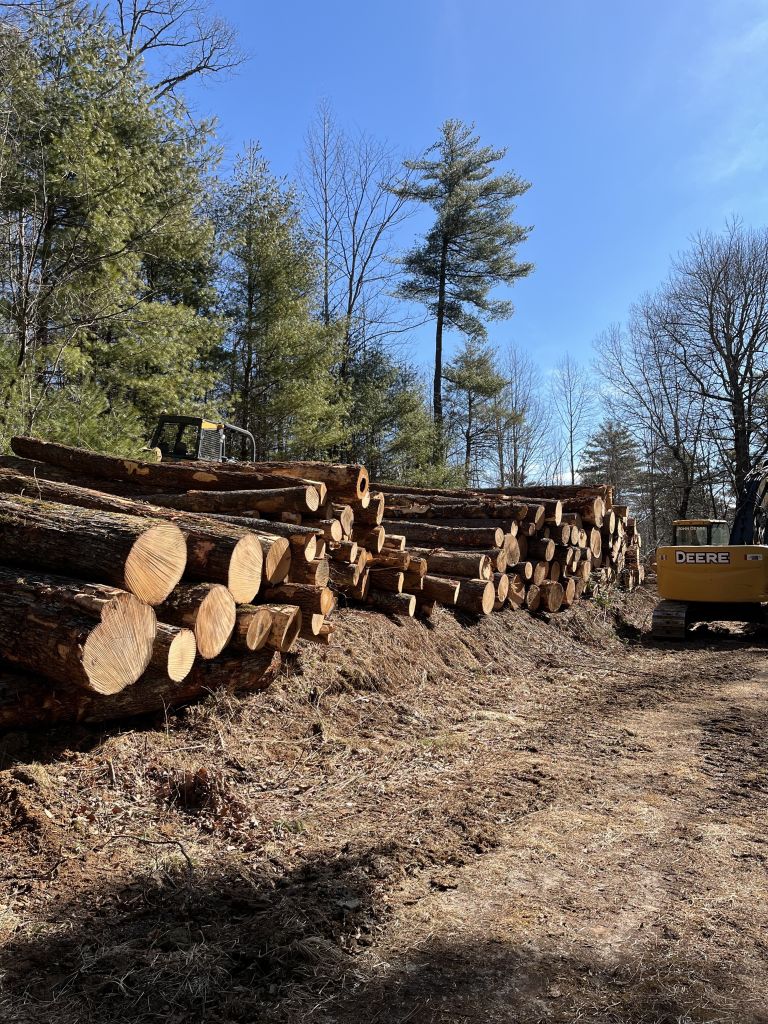
Image: Southside logging near Slick Rock. Credit: Steven Farmer, 2026
Georgia: Chattahoochee National Forest, Chattooga River Ranger District
In the GA portion of the Chattooga River watershed, public land is part of the Chattahoochee National Forest, administered through the Chattooga River Ranger District (CRRD).
Here, timber harvest activities are imminent under the Foothills Landscape Project. Plans for a portion of the Foothills Landscape Project in the Lower Chattooga River watershed are expected to be finalized in early 2026. A public meeting occurred on February 18th, 2026, to review proposed Foothills Landscape Project actions. More information on the Foothills Landscape Project and a summary of the recent meeting can be found in the next article.
Interactive map:
More precise geographic information for completed/planned timber activities under the Loblolly, White Pine, Southside, and Foothills Landscape Projects can be found in the Chattooga Conservancy’s interactive map.
From the basemap, select the layers icon on the left sidebar: . A dropdown arrow next to “USFS Projects – Chattooga & Chauga Watersheds” will reveal sublayers for the Southside Project, Foothills Project, and SC Timber Harvests (White Pine and Loblolly Projects) that can be turned on by clicking the eye icon next to each item.
Prescribed burning in all three states:
The Chattooga River watershed includes portions of NC, SC and GA, and while each of the Loblolly, White Pine, Southside, and Foothills Landscape Projects contain provisions for prescribed burning, not all prescribed burning in the Chattooga and Chauga River watersheds belongs to one of these projects. National forests in each of the three states have additional burn projects, such as APD’s multi-year burn plan from 2024. Unfortunately, advance notice of planned burn activities on a given day is limited, with only the Chattahoochee National Forest in Georgia currently providing alerts via email.
We hope this overview helps you determine which USFS projects are responsible for the logging you notice in the Chattooga and Chauga River watersheds. Please keep coming to us with your observations and questions! Due to unfavorable federal regulation changes promulgated in July 2025 by the current administration, we expect less information about scheduled USFS activities to be publicly available in the future. We will rely even more on people alerting us to activities in our watersheds. Please continue to document your observations from these projects and let us know what you find.
Header Image: A cleared site in the ongoing timber harvest along Double Branch Road, where logging began in 2025 as part of the Loblolly Pine Project. Credit: Jasmine Williams, 2026.