

If you’ve been keeping up with our social media (fb or insta) or checking in on our Federal Actions Tracker, then you’ve likely heard about the two recent proposed rule changes regarding the Clean Water Act (CWA): the November 20, 2025, redefining of “Waters of the United States” and the January 15, 2026, updates to the EPA’s regulations regarding CWA Section 401—the part of the Clean Water Act that grants authority of review to States and Tribes. In this article, we’ll be taking a more in-depth look at the history, content, and environmental impacts of these two changes.
History of the Clean Water Act
The Clean Water Act was established in 1972 under the Nixon administration as a rewriting of the 1948 Federal Water Pollution Control Act (FWPCA). The FWPCA was written at a time when pollution was seen as a matter to be handled by states—this made the law difficult for the EPA, a federal agency, to enforce.
The 1972 CWA rewrite reshaped the law to arm the EPA with the authority to regulate water pollution on a federal level and broadened the Act’s scope to “waters of the United States” (WOTUS). However, the 1972 CWA did not elaborate further on the definition of “WOTUS.” The term has since been the subject of considerable controversy.
While the CWA rewrite placed the lion’s share of authority with the EPA, it did not completely abdicate State authority on water pollution. Section 401 of the CWA installed a direct grant of authority to State and Tribal governments to review relevant proposed activities within their borders and to veto those proposed activities which had not passed review.
Both the “WOTUS” definition and Section 401 have seen regulatory changes throughout the 54-year history of the CWA. For the most part—although not always—these changes have reflected advancements in our understanding of environmental science.
History of “WOTUS”
The 1972 CWA rewrites protected “navigable waters,” defined as “waters of the United States [WOTUS] and the territorial seas.” As questions of applicability arose over the years, tensions grew over how exactly a body of water is defined as WOTUS.
A 2006 court opinion introduced the “significant nexus” standard. This meant that any body of water, including ephemeral or isolated streams and wetlands, would be protected under the CWA if it had a significant physical, chemical, or biological impact on navigable waters. In 2015, the EPA and the Army Corps of Engineers (Corps) formalized this practice in the “Clean Water Rule.”
Under the first Trump administration, the EPA and Corps rescinded the 2015 Clean Water Rule and, in 2020, replaced it with the “Navigable Waters Protection Rule,” which offered a narrower interpretation of “WOTUS,” excluding many ephemeral or isolated streams and wetlands from protection. This was reversed under the Biden administration in 2023. Five months after the reversal, however, the U.S. Supreme Court ruled that if a wetland property does not have continuous surface connection to navigable waters, it is not considered “WOTUS,” despite significant and long-standing scientific evidence that surface connection is not the only indicator of interconnectivity between bodies of water. (Read our overview of the case here). The CWA regulations were accordingly rewritten to conform to the Supreme ruling a few months later.
November 20, 2025: “WOTUS” Rule
Now the CWA regulations are being changed once again. The EPA and Corps are now redefining phrases “WOTUS,” “tributary,” and “relatively permanent,” to bend regulations back to the 2020 rule and roll back protections for ephemeral streams and wetlands even further. The November 2025 proposed rules also remove automatic WOTUS qualification for “interstate waters” and allow certain natural features and human-made barriers to sever CWA jurisdiction if they disrupt consistent waterflow.
Although the Chattooga River is poised to lose one path for automatic protection under “interstate waters,” its main stem continues to qualify for CWA protection in other ways. However, the Chattooga is fed by a network of perennial and ephemeral streams; some of the latter could be threatened under the new proposed rules. Further, the Chattooga’s headwaters in Cashiers are home to many small wetland areas that often face developmental pressure, i.e., permitted destruction through dredging and filling.
The public comment period for these proposed changes closed on January 5th, 2026. We now await the agencies’ responses to comments and their final rule.
January 15, 2025: Section 401 Rule
The November 2025 proposed rules are not the only recent changes to CWA regulations. On January 15, 2026, the EPA published a proposed rule that could substantially limit the ability of States and Tribes to review the environmental impacts of relevant projects within their jurisdiction under Section 401 of the CWA. Relevant projects to Section 401 are defined as any activities that “may result in discharge into navigable waters.”
Like the proposed “WOTUS” changes, the January 2026 proposed rule is largely a reinstatement of changes that were made in 2020, then reversed three years later. During the first Trump administration in 2020, the EPA published a rule that substantially restricted the scope of Section 401 reviews and codified a stringent deadline for State/Tribal review. Prior to the 2020 rule, States and Tribes had regulatory authority to review the overall environmental impact of the proposed activity. In 2020, State and Tribal review was narrowed to a strict “discharge-only” scope. This change was largely undone by a subsequent rule under the Biden administration in 2023.
Now, the EPA is proposing to restore the 2020 rule along with some new additions. The new proposed rule would scrap “as a whole” review to return to a narrow “discharge-only” scope. It is left ambiguous if this includes impacts such as thermal discharge from power plants or impacts to stream flow.
This new proposed rule also introduces new hurdles for Tribal review under Section 401. The CWA grants regulatory authority to Tribes if they are approved by the EPA for “Treatment as State,” (TAS) which is only available to federally recognized Tribes and must be acquired through an application process.
Given the time-sensitive nature of project review, the 2023 rule granted federally recognized Tribes provisional TAS specifically for Section 401. This gave Tribes stalled out in the TAS process an opportunity to maintain their authority to review under Section 401. The new proposed changes would repeal those provisions. Coupled with stringent deadlines for review, these proposed changes would drastically lengthen the process of approval while simultaneously narrowing the window of opportunity for review.
The public comment period on the Section 401 proposed rule closed on February 17, 2026, and we now await the EPA’s response to comments and final rule.
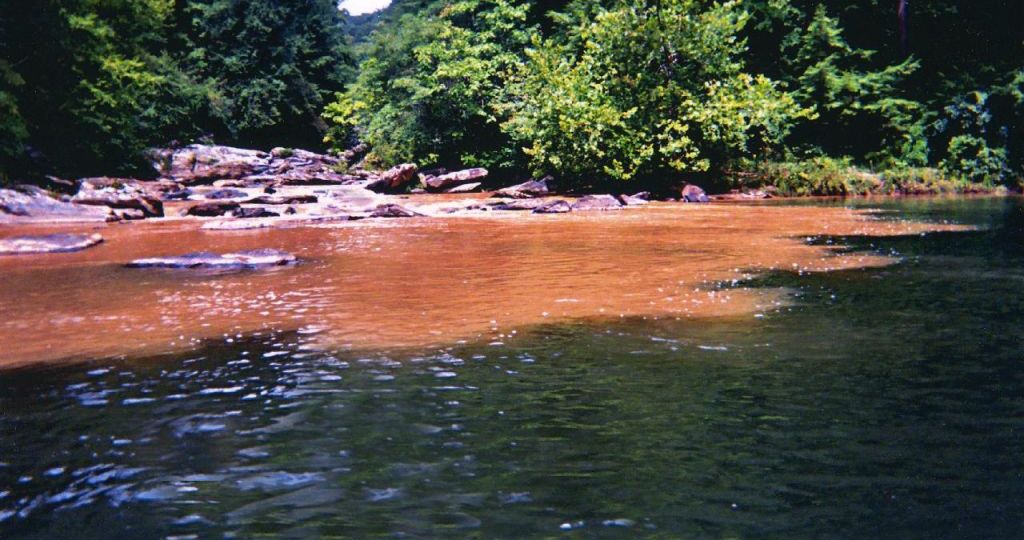
Image: Sedimentation in Stekoa Creek, a major, impaired tributary to the Chattooga River.
Credit: Contributed photo, approx. 2012.