

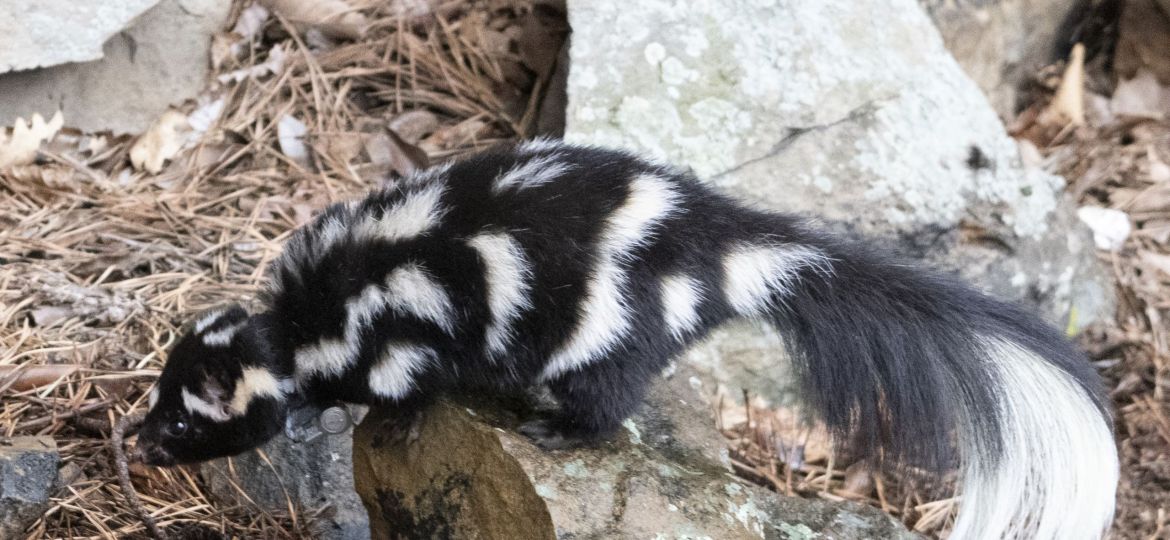
The Eastern Spotted Skunk (Spilogale putorius) is a native of the southeastern and central United States, whose range includes most of Georgia but appears limited to Southern Appalachian mountainous regions in North and South Carolina. In fact, as of 2016, only 22 reported sightings had been documented in South Carolina—so few that researchers aren’t quite sure if the species is exceedingly rare or simply incredibly shy. What they are sure of is that these weasel-like skunks are nocturnal and much warier of humans than their more common cousins, the Striped Skunk. They’re also much smaller, about the size of a large Eastern Gray Squirrell, with interrupted white markings, compared to the pronounced V-shaped blaze of the Striped Skunk.
Not only is the Eastern Spotted Skunk an acrobat, but it is also something of a showboat. Those lucky enough to encounter one may find themselves playing audience to a truly spectacular gymnastic display—when threatened, the Eastern Spotted Skunk warns intruders with a handstand. As adorable as this performance is, observers better not linger. Once balanced on its front paws, the Eastern Spotted Skunk walks towards its intruder and sprays them with the anal scent glands distinctive to all skunks.
The Eastern Spotted Skunk is comprised of three subspecies that make their homes in a variety of different habitats, ranging from Saw Palmetto shrub in Florida to the shrubby prairies and marginal farmlands of the Midwest. The subspecies variety present in the Southern Appalachians may be called the Appalachian or Allegheny (Alleghenian) Spotted Skunk. Across its range, the Eastern Spotted Skunk prefers dense ground cover to hide from predation and plenty of denning opportunities like woody debris, hollow logs, and rocky outcrops. In our neck of the woods, Eastern Spotted Skunks seem to hang around mature hardwood and early successional mixed forests with dense, shrubby understory like rhododendron, mountain laurel, and holly.
Once relatively common across the eastern United States, the Eastern Spotted Skunk is estimated to have seen a more than 90% decline in population across its range—the long-term consequence of a precipitous population crash in the 1940s. Causes for this decline are uncertain, but could include habitat loss; changes in agricultural methods; declining food availability (insects) or disrupted reproduction due to pesticide use; human trapping/hunting; and disease.
Little is known about Eastern Spotted Skunk populations prior to the twentieth century. While we can only speculate as to their pre-colonial numbers, researchers believe that prior to land use changes in the 1940s and 50s, Eastern Spotted Skunks may have actually benefitted from certain human-impacted landscapes. For instance, hedgerows, outbuildings, and marginal thickets of smallholder farmland once offered foraging and denning opportunities for Eastern Spotted Skunks, while modern agricultural machinery, urban sprawl, and the consolidation of small farms have reduced the occurrence of this human-disturbed habitat.
Meanwhile, forest management practices, even those designed to restore critical plant and animal communities, may have complicated repercussions. Recent studies have shown that Arkansas forests managed to benefit the federally endangered Red-Cockaded Woodpecker (Picoides borealis) have become less hospitable to Eastern Spotted Skunk populations—a rare example of habitat restoration conflict between species of concern. While landscape-scale management, including intensive removal of hardwood trees and aggressive, 3-year fire regimes succeeded in fostering a mature, open-canopy pine forest (perfect conditions for the Red-Cockaded Woodpecker to forage and nest), they left behind little in the way of woody cover. Without dense thickets and shrubs, Eastern Spotted Skunks were left with little refuge from predation. Such conflicts demonstrate the challenges of specific forestry practices and underscore the importance of managing for a diverse landscape of heterogeneous habitats.
The Eastern Spotted Skunk is listed as a Species of Greatest Conservation Need in all three states of the Chattooga River watershed; it is considered “imperiled” in South Carolina and Georgia, and “vulnerable” in North Carolina. Luckily, a group of dedicated scientists have formed the Eastern Spotted Skunk Cooperative Study Group (ESSCSG), a team dedicated to better understanding the population distribution and conservation challenges of the Eastern Spotted Skunk. If you see an Eastern Spotted Skunk, make sure to report the sighting here and lend them a hand in the fight to save the skunk!
Sources:
Campbell, J. W., Mengak, M. T., Castleberry, S. B., & Mejia, J. D. (2010). Distribution and status of uncommon mammals in the Southern Appalachian Mountains. Southeastern Naturalist, 9(2), 275–302. https://doi.org/10.1656/058.009.0206
Eastern Spotted Skunk Cooperative Study Group. (2020). Eastern Spotted Skunk
conservation plan. easternspottedskunk.weebly.com.
Gompper, M. E., & Hackett, H. M. (2005). The long-term, range-wide decline of a once common carnivore: The Eastern Spotted Skunk (Spilogale putorius). Animal Conservation, 8(2), 195–201. https://doi.org/10.1017/s1367943005001964
Kinlaw, A. (1995). Spilogale putorius. Mammalian Species, 511, 1-7. https://doi.org/10.2307/0.511.1
Lesmeister, D. B., Crowhurst, R. S., Millspaugh, J. J., & Gompper, M. E. (2013). Landscape ecology of Eastern Spotted Skunks in habitats restored for Red‐Cockaded Woodpeckers. Restoration Ecology, 21(2), 267–275. https://doi.org/10.1111/j.1526-100x.2012.00880.x
Wilson, S. B., Colquhoun, R., Klink, A., Lanini, T., Riggs, S., Simpson, B., Williams, A., & Jachowski, D. S. (2016). Recent detections of Spilogale putorius (Eastern Spotted Skunk) in South Carolina. Southeastern Naturalist, 15(2), 269–274. https://doi.org/10.1656/058.015.0207
Image: Have you seen this skunk? Credit: Eastern Spotted Skunk, by Grayson Smith/USFWS, via U.S. Fish & Wildlife Service (public domain).