

To date, very little official information has been made public apart from the press release itself and a short page on the agency’s website, leaving rural communities and Forest Service employees alike speculating about the agency’s future.
In this article, we’ll take a closer look at what we know so far and how the USFS reorganization may impact the agency, as well as our forests and communities.
As our readers may remember, the move toward reorganization has been anticipated since last July, when Secretary of Agriculture Brooke Rollins published a memorandum announcing a larger restructuring of the Department of Agriculture, which houses the USFS. After receiving backlash from the Senate Agricultural Committee, the proposed restructuring was opened to public comment, which resulted in an “overwhelming majority” (82%) of negative comments.
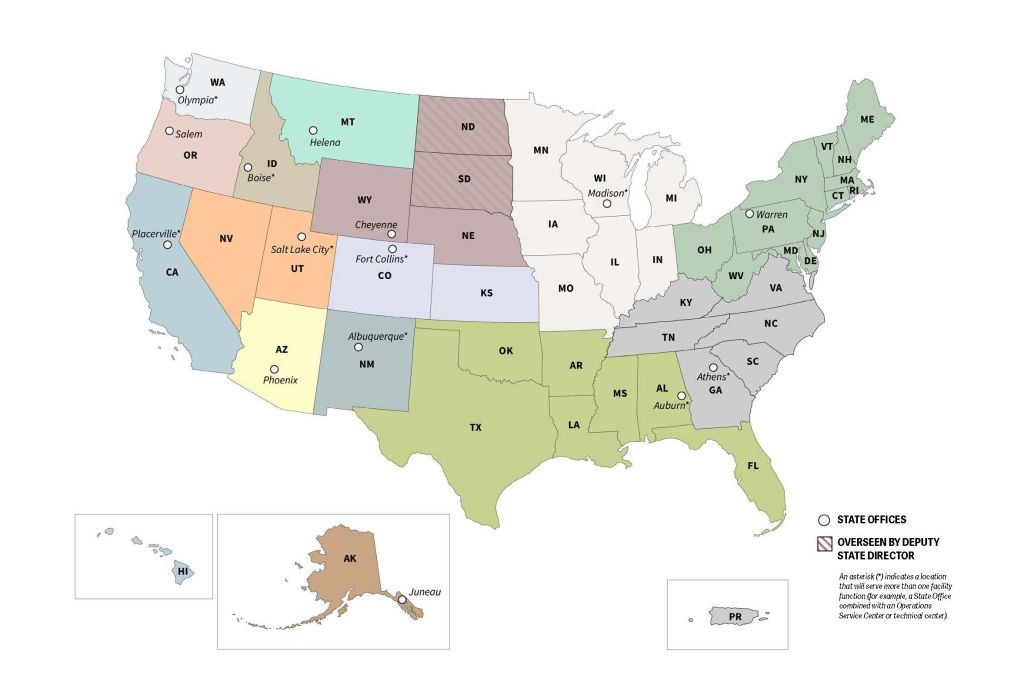
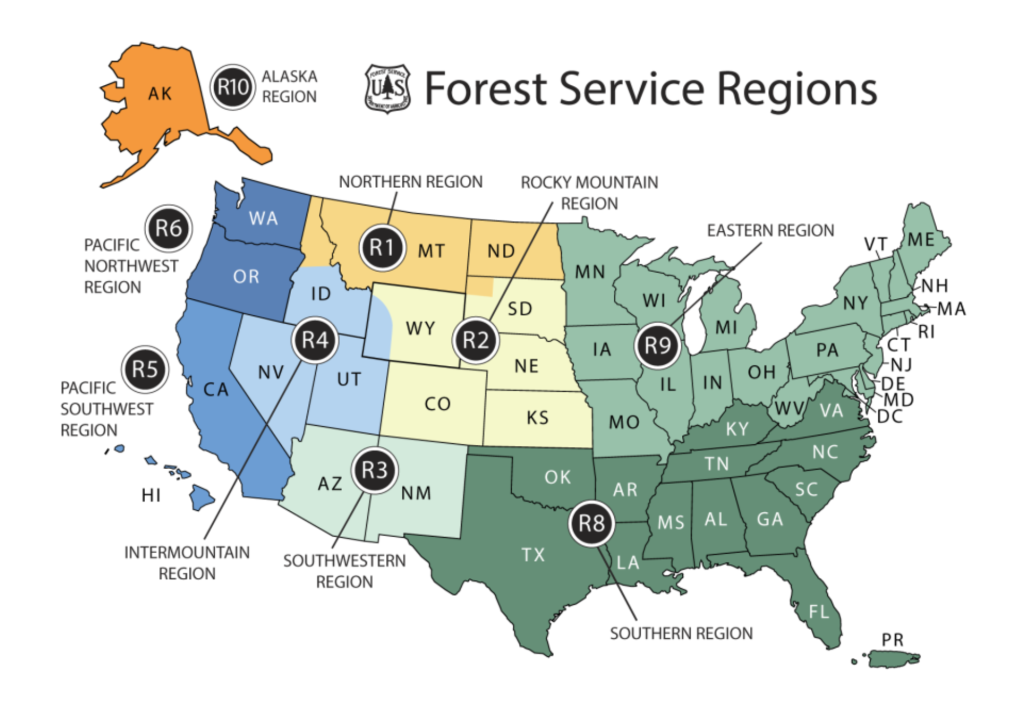
In spite of public pushback, we are now seeing the first major move of the USDA restructure—the reorganization of its largest and most public-facing agency, the U.S. Forest Service. According to the USFS website, the headquarters will be moved from Washington, D.C. to Salt Lake City (SLC), Utah, and all regional offices will be closed down as the agency transitions to a “state-based” model. Additionally, the agency’s Research and Development apparatus will see massive facility cuts, potentially closing upwards of 57 research facilities throughout the country—a reduction by half.
Headquarters
In the March 2026 press release, Secretary of Agriculture Brooke Rollins asserted that the relocation to SLC will bring operations “closer to the landscapes we [the agency] manage,” but critics have voiced concerns that the move is reminiscent of the Bureau of Land Management’s aborted 2019 HQ relocation to Grand Junction, Colorado, and may only lead to irrevocable staff attrition, as it did when nearly 87% of BLM headquarters staff left their positions rather than move out West with the agency.
Environmental groups have also pointed out the disquieting political landscape around public lands in Utah: Utah senator Mike Lee has made headlines for his continual efforts to install legislation allowing the sale of public lands. Utah governor Spencer Cox, who referred to the move as a “big win for Utah,” championed the state’s failed 2024 lawsuit against the federal government that sought to “dispose of,” and ultimately privatize, millions of acres of Utah public land. Utah’s anti-public-land association has led some to question the long-term political implication of an SLC headquarters for the USFS.
States and Regions
The agency will also be closing its regional offices and abandoning its long-held regional model in favor of a quizzically named “state-based” model—despite the fact that only 7 of the 50 U.S. states will constitute their own management area. The other 43 states will share state offices; for example, the “state office” for Maine will be in Warren, Pennsylvania.
While USFS Chief Tom Schultz estimated that around 500 employees will be asked to relocate during reorganization, Associate Chief Chris French indicated that transitioning to the state-based model may affect around 5000 employees from the Washington, D.C. and regional offices. French clarified that changes to regional offices will not be administered until fall 2026—after what is expected to be a particularly demanding fire season.
The Southern regional office in Atlanta, GA will be shuttered and a “Southern Appalachian State Office,” located in Athens, Georgia, will take its place—as an Operations Service Center for Georgia, the Carolinas, Tennessee, Kentucky, and Virginia. The Athens location will also maintain its current capacity as a Research and Development (RnD) facility.
Research and Development
Until the end of fire season, the reorganization effort will focus on its headquarters move and the closure of nearly half of the USFS RnD facilities throughout the country. The USFS research apparatus currently produces world-leading research on forest ecology, hydrology, and natural resource management. Science advocacy groups, such as the Union of Concerned Scientists and the Bulletin of the Atomic Scientists, have expressed concern that RnD closures represent a targeted dismantling of environmental research infrastructure.
The agency has refuted the accusation, claiming that it only seeks to close down understaffed research facilities affecting the agency’s overhead. However, many such facilities are likely understaffed as a result of the DOGE cuts of 2025 that led to an exodus of almost 6000 USFS employees. Critics argue that self-inflicted understaffing is being used to justify dismantling research programs—further evidenced by the recent presidential budget for the USDA which proposes, pending congressional approval, to completely zero out all USFS research funding.
In our neighborhood, the Southern Research Station in Asheville, NC, will remain. Facilities in Clemson, SC, however, are slated for closure—leaving researchers in the area unsure of what the future holds not only for themselves but for the facility’s long-term research projects on endangered wildlife and the effects of prescribed fire. Such programs—including collaborative programs with Clemson University—will likely be impacted, some fear terminated, in the coming shuffle.
The Elephant in the Room
Throughout the reorganization announcement, the agency has sought tirelessly to reaffirm to the public that its ultimate goal is to produce a leaner, more agile Forest Service capable of tackling the demanding issues at hand—chiefly, the increasingly prevalent issue of wildlands firefighting. By reducing the overhead of regional administration and environmental research, USFS claims, the agency will be able to better allocate resources to the more pertinent agency obligations: fighting fire and producing timber.
However, the agency also plans to soon offload firefighting to a new federal agency: the U.S. Wildland Fire Service. As indicated by Chief Tom Schultz, an independent feasibility study on this transition is scheduled to be completed as early as fall 2026. The question looms: with firefighting likely to be annexed to another agency, a defunded and wilting research branch, and a headquarters in a state known for privatizing profits from public lands—what agency obligation will be left?
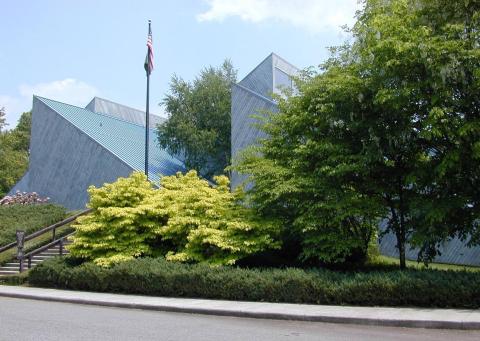
Header Image: the Southern Research Station, located in Asheville, NC, will remain open, but some of the Research Work Units under its purview, such as the Center for Forest Disturbance Science in Clemson, SC, are likely to close under the reorganization plan. Image credit: U.S. Forest Service.