

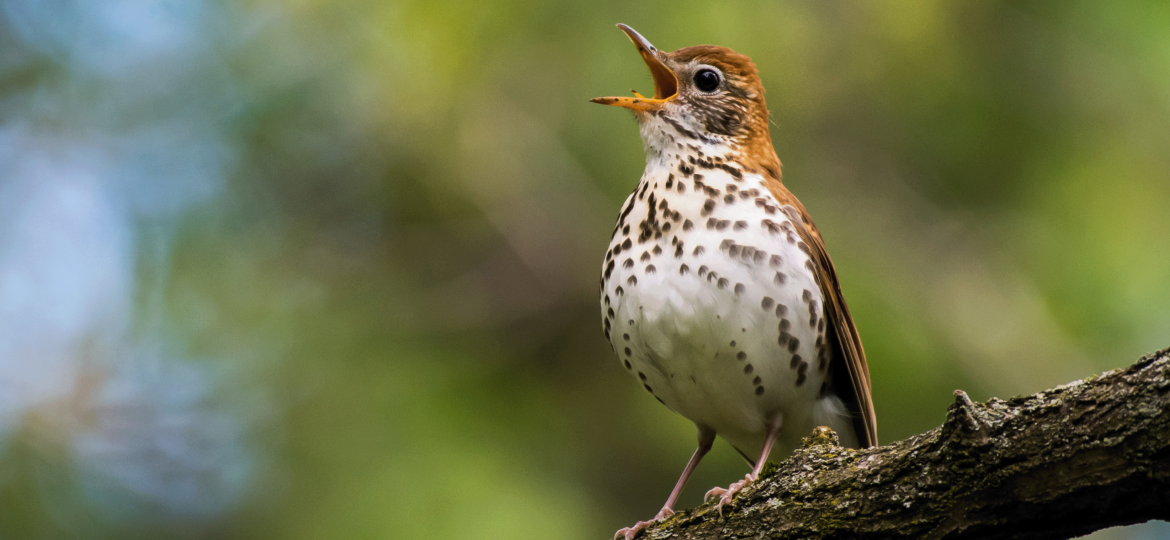
A member of the family Turdidae, it is closely related to other thrushes like the American Robin and the Veery. Thrushes are known for their complex melodic songs, and the Wood Thrush is no exception! The Wood Thrush’s song is considered by many to be one of the eastern United States’ most beautiful, often described as ethereal and flute-like. Sung only by males, this large repertoire of songs is used for defending territory and attracting mates. A male Wood Thrush can sing up to 50 distinct songs! Their song usually consists of three parts, often ending in a two-part harmony. This harmony is created by the syrinx, a Y-shaped vocal mechanism located at the bottom of their esophagus. Air traveling down the trachea splits when it reaches the syrinx and travels to the lungs. As a Wood Thrush sings, the syrinx can independently open and close streams of air coming from each lung, allowing for the possibility of harmonization. The next time you hear a Wood Thrush sing, pay attention to the last part of their song, and you will notice the buzzing trill created by their syrinx!
Wood Thrushes spend their summer months in eastern North America, raising up to two broods in a single mating season. They breed in mature deciduous forests, residing in the understory in saplings or shrubs like spicebush, rhododendron, and blueberry. Unbroken forest canopy and forest continuity are important factors in determining suitable Wood Thrush habitat. While they can nest in parks and forests near suburban areas, these types of sites come with an increased risk of nest parasitism from Brown-Headed Cowbirds. An open forest floor with decaying leaf litter is preferable, as this is where Wood Thrushes source most of their summer food. A clutch-laying female requires 10–15 times the amount of calcium in her diet as a similar-sized mammal. Calcium is usually sourced from invertebrates. Wood Thrushes are year-round omnivores; however, fatty fruits like holly, spicebush, and dogwood become desirable sources of nutrition during fall migration.
Wood Thrushes are considered a Tipping Point species; according to Partners In Flight, Wood Thrush populations in North America declined by around 60% from 1970–2016. The Road to Recovery (R2R) initiative defines a Tipping Point species as a species that has lost 50% or more of its population in the last 50 years, and is in danger of losing another 50% in the next 50 years. Habitat loss is believed to be the leading cause of Wood Thrush decline. Logging and development are widespread contributors to fragmentation of suitable habitat, and both the Cornell Lab of Ornithology and the American Bird Conservancy note the protection of intact mature hardwood forests as a vital conservation strategy. With this in mind, the existence of mature second-growth and old-growth forest in the Chattooga River watershed provides crucial habitat for the species.
Header Image: Wood Thrush by John Petruzzi; Cornell Lab of Ornithology | Macaulay Library.