

A guest article by botanist Charles E. Zartman, PhD.
On the eastern side of the Blue Ridge Continental Divide, particularly along its southeastern escarpment, hydroelectric projects pepper the region, nestled in tight steep gorges. One such project, which engulfed the lower Chattooga and its confluence with the Tallulah River, resulted in the formation of Lake Tugalo. Constructed from 1917-1923, Lake Tugalo is surrounded by hardwood mesophytic forests, its banks cut by small creeks of a steepness and pitch which rival the Chattooga’s headwaters tumbling off the Highlands-Cashiers Plateau.
It is no coincidence that these primary tributaries feeding into human-made lakes of the region are rich in a disparate hodgepodge of plant species—representing tropical disjuncts and northern temperate species. The main criteria for dam location is gradient, and gradient combined with water makes a recipe for waterfalls. The humid microclimates created by the spray zones of tumbling water create an ideal refuge for tropical “vagrants” to tolerate a temperate climate.
One exceptional example of this biogeographic curiosity can be found in full splendor in grottos along Bad Creek, the penultimate tributary on the Georgia side of Lake Tugalo (i.e., the inundated lower reach of the Chattooga River) prior to its confluence with the Talullah. The tumbling waters of this tributary harbor extensive populations of Vandenboschia boschiana (synonym: Trichomanes boschianum), the Appalachian Bristly Filmy Fern, which belongs to the predominantly pantropical fern family, the Hymenophyllaceae.
Justly named the “filmy” ferns due to their unique shared quality of leaf laminae (blades) consisting of a single cell layer, these plants emit a shiny transparent green glow from the dark recesses of grottos and irregular rock formations. The Appalachian Bristly Filmy Fern is a state-listed Endangered species in NC and is likewise critically imperiled in SC and GA. Its habitat is restricted to these perpetually moist spray zones below 1000 ft. elevation.
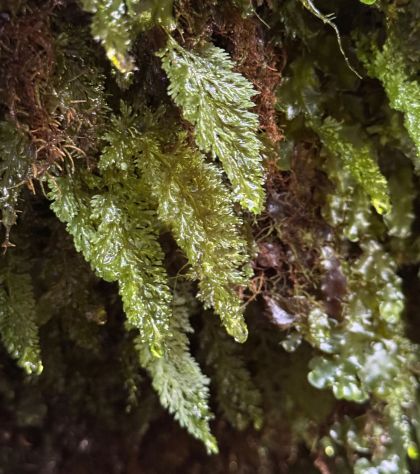
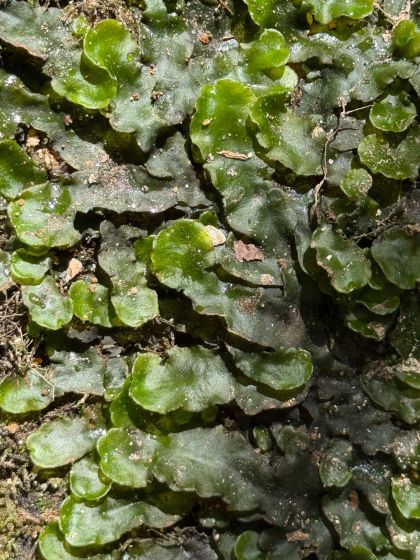
A stone’s throw away from the radiant colonies of the Bristly Filmy Fern is another curious spore-producing plant, growing tightly fixed to boulders mid-stream. The hornwort Megaceros aenigmaticus surely loses in physical beauty to the Appalachian Bristly Filmy Fern, but makes up for it by its puzzling evolutionary history.
This primitive hornwort is dioicous, that is, males (antheridia-bearing plants) and females (archegonia-bearing plants) occur on separate individuals. A cruel twist in the biogeographic history of this plant over millions of years oddly left males and females isolated from one another by watersheds.
The modern-day distribution of the sexes in M. aenigmaticus has left males isolated to the upper Pigeon River and females to watersheds such as the Hiwassee and Coosa far to the southeast. Such a sad turn of fate has rendered this Georgia state-listed Threatened species unable to reproduce sexually for millennia. The genetic consequences are that the Appalachian populations of the species have a clonal structure (reduced genetic variation) and are estimated to have diverged from the nearest sexually reproducing populations in Mexico nearly 800,000 years ago.
These two fascinating species represent two lineages of spore-bearing plants—known as cryptogams—which conquered harsh conditions of terrestrial habitats during the Permian epoch (298.9–252.2 million years ago), and they are only a hop, skip and a jump away from the Lake Tugalo boat ramp, along the wonderfully scenic Bad Creek. Due to sheer remoteness, tributaries of the lower Chattooga River inundated by Lake Tugalo remain understudied botanically. Who knows what other gems of the plant world an intrepid future botanist may reveal in these parts!
The Chattooga River watershed is one of the most biologically diverse in the world; this includes the land surrounding Lake Tugalo. Many rare/unique/endangered species such as the Appalachian Bristly Fern and hornwort M. aenigmaticus have been affected by inundation and would greatly benefit from restored habitat opportunities. The Federal Energy Regulatory Commission will begin consideration of relicensing the 100+ year old Tugalo Dam in 2031. The reasons for dam decommissioning are comprehensive and compelling. Chattooga Conservancy is committed to education and conversation about the tremendous economic, cultural, and environmental benefits that would be gained through Tugalo Dam decommissioning.